

**Get Local Reviews That Stick →
For home service brands in 2026, location-specific reviews beat broad, non-local feedback for trust and local visibility. If you’re choosing a geo-targeted review service or a generic option, you’ll see stronger Map Pack traction and buyer confidence with reviewers who match your service area.
However, volume and speed still matter for star ratings and buyer proof. So the real question is not “Which is good or bad?” It’s how each approach maps to your ZIP codes, your growth goals, and your risk tolerance for review flags. This guide compares both paths with clear criteria, trade-offs, and ROI framing so you can back your choice with data and logic.

What Home Service Businesses Actually Need From Online Reviews
Local work wins or loses on neighborhood trust. Per InstantBizReviews Stats, “79% of people trust online reviews as much as word-of-mouth referrals.” That level of trust moves booked jobs for plumbers, roofers, and HVAC teams. But trust is not the only yardstick. You also need reviews to nudge Google’s local algorithms, feed buyer proof on the right platforms, and keep a steady pace of new feedback without tripping spam checks.
In addition, home services are tied to place. ZIP-code relevance matters because you drive or dispatch within set service areas. For search engines, proximity isn’t a side note. Google weighs reviewer proximity when ranking local results, so signals tied to the reviewer’s location can change what shows up first. If your reviews signal the same towns and suburbs you serve, your profile feels real to both humans and algorithms.
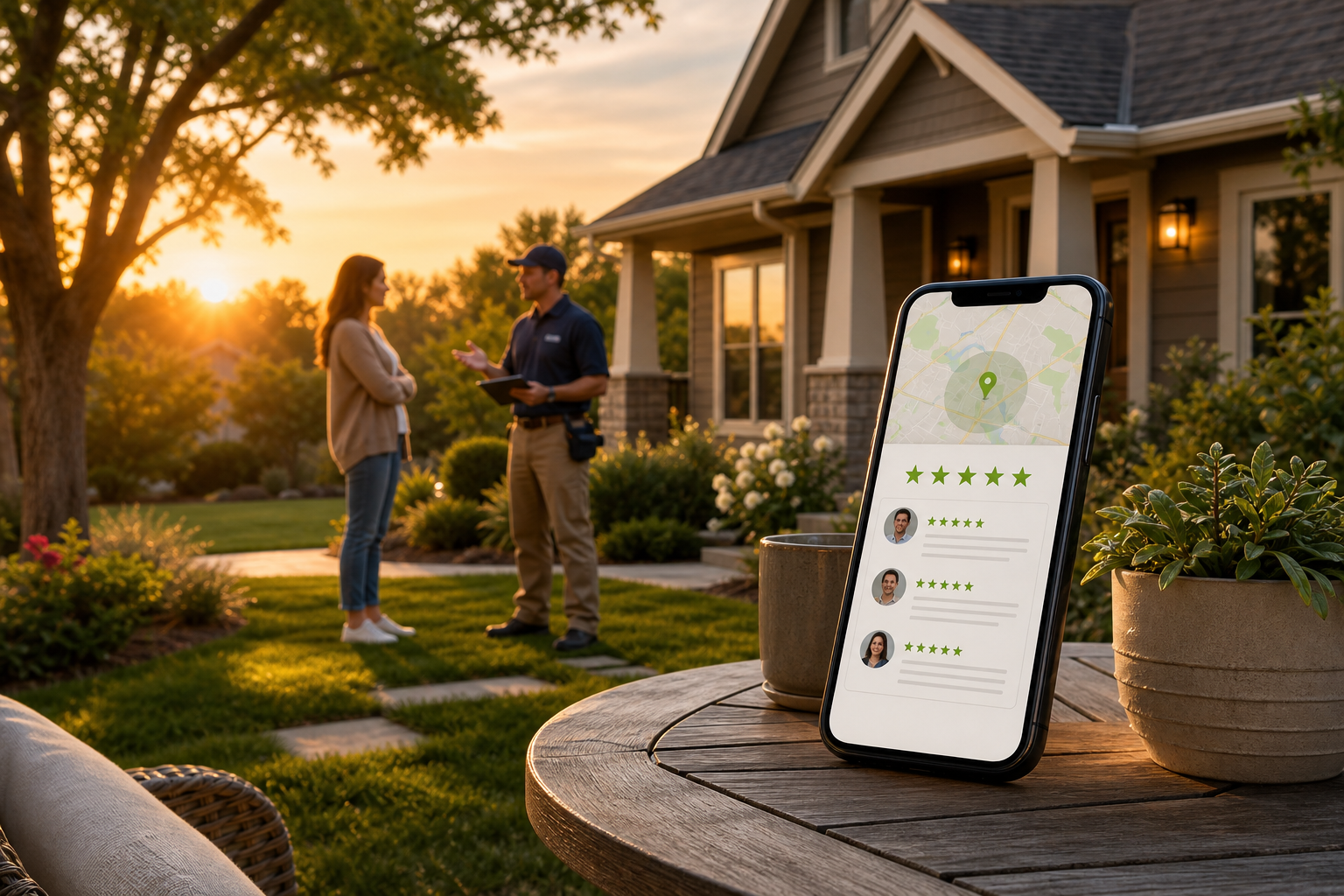
Therefore, your review plan should reflect how buyers shop. Homeowners skim the Map Pack, look at total ratings, then scan 3–5 recent reviews for details. They look for their town name, photos of similar jobs, and signs the work was done nearby. Generic comments from far-off places feel thin, and risk getting flagged, which hurts your stick rate and costs time to replace.
To ground the local search context, see the background on how proximity influences discovery in Local search (Internet). You can also scan the practical playbook on platform choice and setup in the internal guide: Google review service for home services.
The five evaluation criteria that matter
- Local relevance: Does the review reflect your ZIP codes, towns, and service radius?
- Map Pack impact: Does it add signals that influence local discovery?
- Trust signals: Do real buyers in your area see “people like me” proof?
- Review velocity: Can you add reviews at a steady, natural pace?
- Platform diversity: Are you building proof where your buyers check?
“Home services are inherently local — ZIP-code relevance matters.” — InstantBizReviews
Geo-Targeted Reviews: How Location-Specific Feedback Performs for Home Services
Geo-targeted reviews are written by verified local accounts that match your service area. The goal is to amplify proximity signals that Map Pack systems read, while also giving real homeowners confidence that you work their neighborhood. For service-area businesses, that alignment is the difference between “seems legit” and “feels off.
InstantBizReviews offers demography-based and geo-targeted review options, which helps you mirror the makeup of real buyers. For example, reviews from verified local IP addresses carry more algorithmic weight. That added weight is not a trick; it’s a result of signals lining up: local account history, device IP, and place names that match your jobs.
In addition, SEO-optimized review content includes local service keywords naturally. A review that says “replaced water heater in Oak Park” does two jobs at once: it reads like a real job recap and it echoes a high-intent search phrase paired with a location. In 2026, these small cues compound across tens of reviews and can tip your listing into the Map Pack for more queries.
Strengths
- Local SEO lift: Proximity and place-name cues align to your radius.
- Map Pack relevance: More reviews from nearby accounts can improve visibility.
- Buyer trust: Real neighborhoods named in the text push hesitant homeowners to call.
- Demographic fit: You can reflect household types that match your typical jobs.
Trade-offs and setup needs
- Higher cost per review: You’re paying for real, verified local accounts and care.
- Slower to scale: You add reviews at a natural pace to reduce flag risk.
- Data needed: You provide location coverage, service lines, and brand voice.
- Process overhead: You may coordinate monthly themes (e.g., “spring A/C tune-ups”).
For a deeper primer on profiles and keyword placement that support this path, scan the internal explainer: Google review service for home services.
Generic Reviews: The Broad-Reach Approach and Where It Falls Short
Generic reviews aim for fast volume, low cost, and simple setup. You often get a batch of short, positive comments from non-local accounts spread across days or weeks. The immediate upside is a quick bump in your average rating and review count. If your profile is new or under 3.5 stars, that early lift can change buyer behavior fast.
However, generic reviews lack geographic metadata that local algorithms prioritize. Without proximity signals, they contribute less to Map Pack placement. Moreover, platforms increasingly detect location mismatches and flag reviews. A flood of non-local praise may trigger filters that reduce your stick rate, which forces rework to replace removed comments.
On the human side, home service customers look for reviewers in their own area. A homeowner in Plano scanning feedback from Seattle accounts will feel a gap. Even if the words are kind, the mismatch can stall a call or click. In short, generic volume helps at the surface level, but it can struggle to win the “is this team good near me?” check.
Where generic reviews make sense
- You need a fast baseline of fresh reviews to offset an old incident.
- Your jobs span a wide metro and you lack clear local clusters today.
- Budget is tight this quarter, and you plan to shift to local later.
Where they fall short
- Thin local SEO boost for Map Pack queries tied to neighborhoods.
- Higher flag risk, especially if account locations look far away.
- Less persuasive for homeowners who want same-town proof.
Also Read!
How to Get More Google Reviews for Your Home Service Business
Head-to-Head: Geo-Targeted vs Generic Reviews Across 5 Key Dimensions
This section compares both paths side by side on what home service teams measure: local SEO impact, cost per review, authenticity signals, scalability, and longevity/stick rate. The point is not to crown a winner in every row. It’s to show where each path fits so you can choose with intent.
First, local SEO impact. Geo-targeted reviews from real accounts with verified IP addresses map to the proximity cues that influence the Map Pack. That means they do more than raise your stars. They can help you appear for more near-me searches. Generic reviews add social proof, but they bring little local lift and can be discounted by filters.
Second, cost per review. Generic options usually win on price. You can add more comments for less money.
Yet cost alone ignores stick rate. If half the batch gets flagged, your effective price doubles. Geo-targeted reviews cost more up front but tend to stick because the signals look natural.
Beyond price
Third, authenticity signals. Homeowners scan for town names, job types, and photos. Geo-targeted content puts those cues in the text. SEO-optimized reviews boost visibility beyond just star ratings, and they read like real work logs. Generic copy sounds polished but vague, which is less convincing at the point of decision.
Fourth, scalability. Generic volume scales faster. If you need to go from 5 to 50 reviews in a month, this path can do it. Geo-targeted work is paced to avoid patterns that trigger filters, so it scales with more care.
Fifth, longevity and stick rate. Accounts with local history, matched IPs, and natural language tend to survive audits. InstantBizReviews provides a 15-day replacement warranty for flagged or removed reviews, which protects your spend while reinforcing a process that aims to keep removals low.
Comparison at a glance
| Dimension | Geo-Targeted Reviews | Generic Reviews |
|---|---|---|
| Local SEO Impact | Strong proximity and place-name signals | Weak; limited Map Pack relevance |
| Cost per Review | Higher up front | Lower up front |
| Authenticity Signals | High; real neighborhoods and job details | Low to medium; broad and vague |
| Scalability | Moderate; paced for safety | High; quick volume |
| Longevity/Stick Rate | High; verified IPs and natural cues | Variable; higher flag/removal risk |

Furthermore, if you value risk controls, the replacement warranty acts as a backstop while you build momentum. If you care most about hitting a review count milestone this month, generic can help you get there. But if your aim is more calls from the Map Pack over the next 90 days, a geo-first plan is the better bet.
**Start building local proof today →
Cost Comparison: What Home Service Businesses Should Expect to Invest
Prices vary by market, platform, and scope, but the trade-off is consistent: geo-targeted work costs more per review, while generic work costs less per review. The gap reflects real inputs. Local accounts with verified IP addresses and natural, SEO-aware copy require more sourcing and editorial time than short, broad comments.
Therefore, you should frame ROI around outcomes, not unit price. Higher per-review cost offsets lower flag rates and better ranking impact. If geo-targeted reviews help you gain Map Pack visibility in your ZIP codes, the returns stack each month as organic calls rise. In contrast, a cheap batch that gets removed yields near-zero long-term value.
In addition, anchor ROI to lead value. Home service leads from local search often exceed $50-200 in value. If a month of geo-targeted work helps you add just a handful of these, the math favors the approach even with a higher unit cost. For teams pricing next steps, InstantBizReviews offers structured ordering through their order page, so you can align spend with your service areas and seasonality.
**See packages and timelines →
Verdict: Which Review Approach Wins for Home Service Businesses
Home services are fundamentally local, plumbers, HVAC, roofers serve specific areas. That simple reality pushes the geo-first approach ahead for trust and long-term visibility. A geo-targeted review service aligns with Map Pack signals, calms buyer doubt with same-town proof, and tends to stick through platform audits. As a result, it compounds gains over quarters, not just weeks.
That said, generic reviews are not useless. They can supplement volume when you need a quick baseline or want to smooth monthly velocity. Use them with care, spread them over time, and avoid patterns that look artificial. Think of them as filler, not the frame. The frame should be local.
InstantBizReviews specializes in geo-targeted and SEO-optimized review delivery, backed by authentic reviews from real accounts with verified IP addresses and a 15-day replacement warranty for flagged or removed reviews. That mix covers risk and results. It also matches how homeowners shop in 2026: local first, then stars, then details.
“We’ve been able to secure reviews from real customers that reflect our service quality. The reports were incredibly detailed too.” — Owner, Brooks Home Repair
Quick Decision Guide
- Choose geo-targeted if you need Map Pack lift, same-town proof, and durable reviews.
- Choose generic if you need fast volume at low cost to raise your visible count.
- Consider a blended plan if you want steady velocity plus local cues in key ZIP codes.
 → Grow Map Pack Calls,” with icons for a map pin, wrench, and phone)
For hands-on help scoping locations, platforms, and pacing, reach out or order directly.


